RoBosun-Tapper: Robotic Facade Inspection
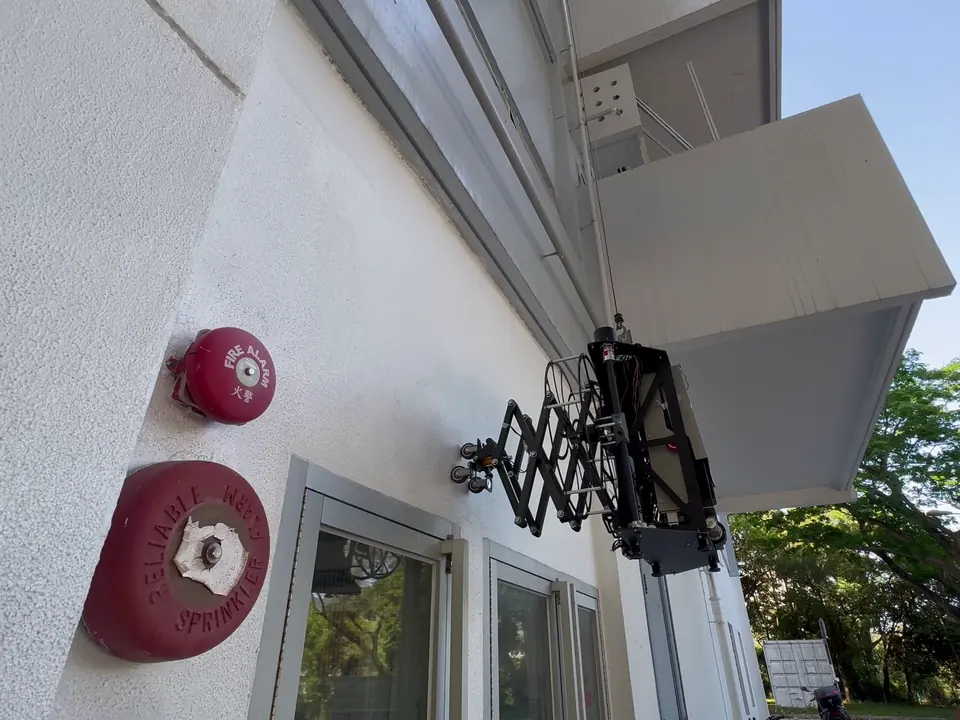
Cable-driven facade hammer-testing robot
Project Overview
RoBosun-Tapper is a cable-driven robot that performs hammer tests on high-rise building facades. It combines robotic positioning, automated tapping, and impact-signal analysis to support facade inspection.


RoBosun-Tapper / SUBSYSTEMS
Explore the robot assembly
Use the slider to extend the arm. Drag or swipe horizontally to rotate the view.
Scroll down to separate the assembly, or use the slider. Drag horizontally to adjust yaw ψ around the vertical axis.
Loading the local 3D assembly when it comes into view. Robot photos and subsystem descriptions are also available below.
- Reference / Chassis & battery case
- The main chassis and battery case stay in place as the reference for the assembly view.
- 01 / Guarded propellers
- The two propeller units move slightly outward from the chassis. Their motors and blades come from the CAD; the circular guards were reconstructed from the reference image.
- 02 / Drive motors & bearings
- The paired motor and bearing assemblies stay mounted to the chassis during the reveal.
- 03 / Scissor linkage
- The scissor links extend the arm straight out from the chassis. Their motion follows the CAD link spacing; the displayed stroke is illustrative.
- 04 / Tapper & casters
- The CAD tapper assembly, including its caster wheels, travels with the end of the extending linkage.
Project Details
Selected Contributions
- Led the mechanical and systems development of the autonomous facade inspection platform.
- Moved the system through field testing and into more than 12 commercial facade inspections within one year.
- Reduced structural weight while improving stability, then designed and manufactured the electrical and control boxes.
- Developed C++ and Python ROS nodes and APIs for the operator interface, navigation, and signal-processing workflow.
- Integrated laser sensors, IMU, LiDAR, and computer vision for positioning and defect analysis.
- Supported industrial safety compliance, including Form 5 certification work with a Registered Professional Engineer.
Retractable tapping mechanism
The tapping mechanism extends from the robot towards the facade and retracts for travel. My work covered the linkage design, compact packaging, and the arrangement of the tapper and thrusters for contact with the wall.